





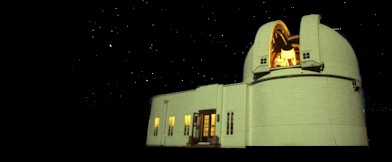
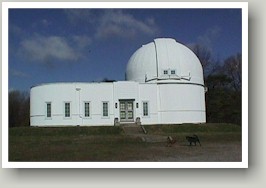
The Link Observatory was built between 1937 and 1939 by Dr. Goethe Link, a prominent Indianapolis surgeon. Dr. Link was an avid amateur astronomer and naturalist. The observatory is located on land adjacent to the Link's home and where Helen Link's daffodil beds are still an attraction for countless Hoosiers every spring.
The Link Observatory's principal instrument is a 36-inch reflecting telescope. Dr. Link acquired the 36-inch diameter Pyrex mirror blank for the telescope's primary mirror from the Corning Glass Works. The mirror blank was a surplus scaled down honeycomb-backed casting, made as an experimental precursor to the pouring of the historic 200-inch mirror for the Mount Palomar Observatory.
The telescope was constructed entirely in Indianapolis. Members of the Indiana Astronomical Society assisted Dr. Link in constructing a large mirror-grinding machine and carried out the optical work. The telescope's massive mounting was fabricated at a machine shop also in Indianapolis. When finished in 1939, only eight observatories in the United States possessed telescopes of equal or larger size.
This large telescope requires solid support. The 200-ton concrete pier sits on bedrock and extends 30 feet above ground level. The base is 9 by 17 feet. The observatory building was then erected around the finished pier. The frame of the building is made of massive oak posts and beams that were cut in the forest just a few miles away. The interior is finished with hardwood floors, paneled knotty-pine walls, and beamed paneled ceilings.
The dome is 34 feet in diameter and has a moving weight of 34 tons. Two shutters weighing one ton each open to provide a sky-viewing slit 8 feet wide. The flat roof over the lecture hall originally supported a second, smaller dome that housed Dr. Link's personal telescope, a 5-inch Zeiss refractor. This dome was removed in 1948 and can still be seen on the grounds across the parking lot from the main building.
Donation to Indiana University
Dr. Link founded the observatory to aid in the advancement of astronomy in Indiana. Use of the observatory was offered to all the surrounding colleges and universities. The Astronomy Department of Indiana University took advantage of this offer by creating the position of Research Fellow and hiring an astronomer, Dr. James Cuffey, to work at Link Observatory.
This relationship was renewed after World War II and in 1948 Dr. Link donated the observatory to Indiana University. At that time a 10-inch photographic telescope was added to the observatory. This instrument was housed behind the main building in a roll-off roof shelter. It was used from 1949 through 1967 to photograph the sky in search of asteroids or minor planets. Almost 7,000 8 x 10-inch glass photographic plates were exposed, and over a hundred new asteroids were discovered from this location! With the demise of photographic plates as a viable research medium, the 10-inch lens was returned to the Cincinnati Observatory and its J. W. Fecker mounting sold. In 2015, the building was renamed the Tanager Hill Observatory by the IAS and a new 14-inch Schmidt-Cassegrain telescope was installed on a modern, computer-controlled mount. The new mount is user-friendly and provides rapid access to astronomical objects for public outreach programs.
For almost 50 years, the Link Observatory was used by graduate students and astronomy faculty members for astronomical research. In the mid-1960's, the 36-inch was redesigned to carry heavier astronomical instruments. However by the late 1980's, increasing light pollution from Indianapolis and nearby communities made the sky at Link too bright for the most sensitive instruments. Today, I.U. astronomers conduct their research with the remotely controlled 3.5 meter (138-inch) WIYN robotic telescope at the Kitt Peak National Observatory near Tucson Arizona, where more than 80 percent of the nights are clear.
The Indiana Astronomical Society
Indiana University continues to own and maintain the Link Observatory. In 1988, IU granted the Indiana Astronomical Society access to the facility for the benefit of its members and public outreach. The Society has its monthly General Meeting at either Link Observatory or at the nearby Mooresville Public Library on a Saturday nearest the 3rd Quarter Moon. The meetings begin at 7 P.M. and usually include a guest speaker and are held whether the sky is cloudy or clear. Afterwards, if the skies are clear, we transit to Link for an observing session. This provides an excellent opportunity for visitors to look through different types of telescopes, ask questions and learn more about amateur astronomy.
- A 1940 article about the Link observatory from Popular Astronomy magazine.
- A 1951 summary of early use by Indiana University. From the Astronomical Journal.
- 90th Anniversary (YouTube) presentation of the history of Goethe Link Observatory, given by IAS Historian, Thomas Borlik, on May 20th, 2023.
- Driving directions to the Link Observatory.